
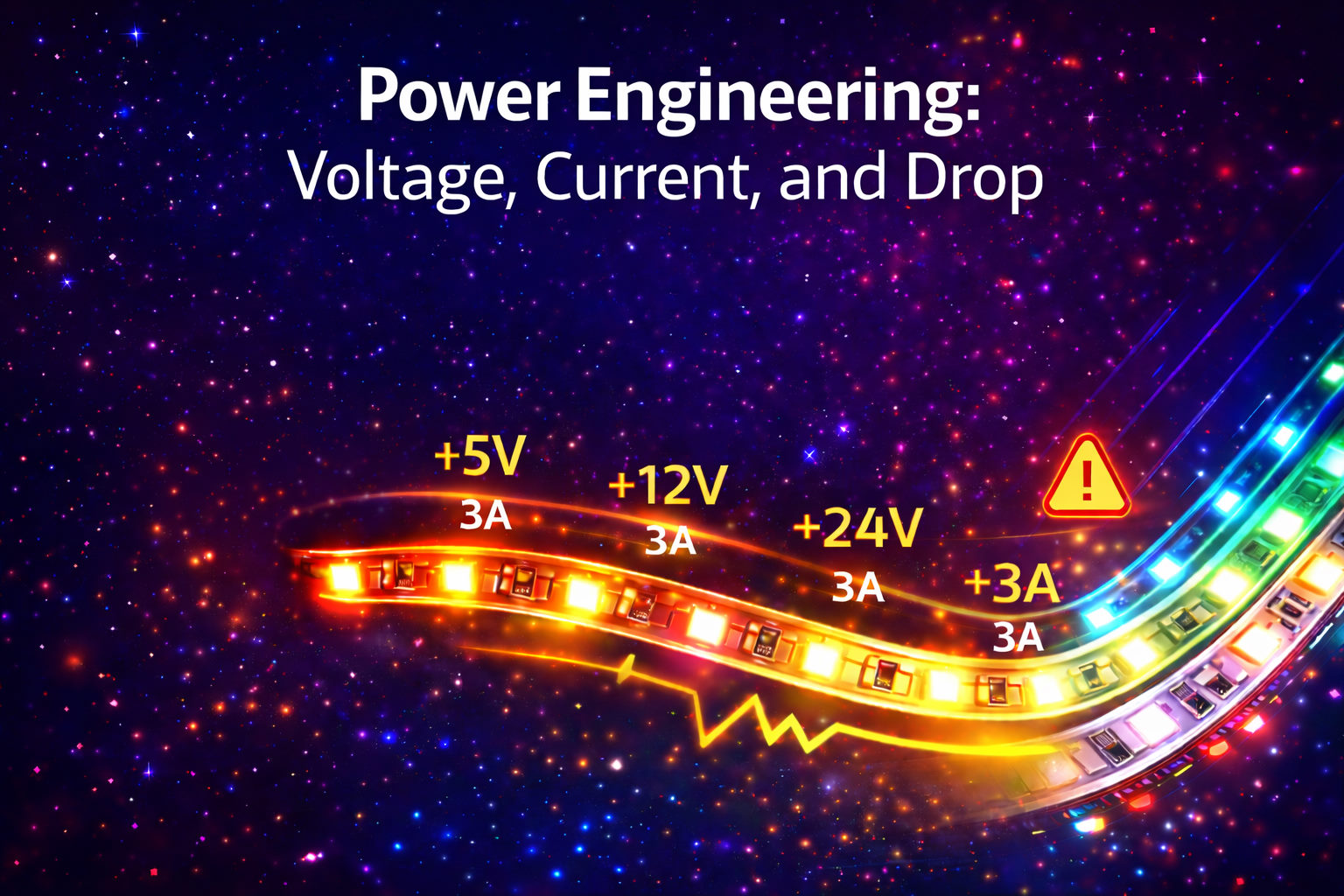
Power design is one of the most important parts of any addressable LED installation. This is also where many common mistakes occur, leading to uneven brightness, color distortion, overheating, or unstable operation.
Calculating power supply requirements
A project should begin with determining the maximum possible power consumption. In practice, a digital RGB strip reaches its highest power draw when displaying full white, because all color channels are active at the same time.
A safety margin should always be added to the calculated load. In professional installations, a reserve of 20–30% is commonly used to improve power supply operating conditions and reduce heat stress.
Why 5V systems are more demanding
5V strips offer the highest resolution, but they require more careful power planning. Lower voltage means higher current for the same power level, which results in more significant voltage drop along both the strip and the power cables.
The most common symptom is color shift toward the end of the strip, especially on longer runs where blue and green channels weaken before red.
When to choose 12V or 24V
12V and 24V systems are much more convenient in larger installations. They allow longer runs from a single power feed, reduce voltage drop, and lower the required cable cross-section.
In practical terms:
- 5V is best where high detail is required,
- 12V is an excellent all-round compromise,
- 24V performs best in large-scale installations and long lighting runs.
Power injection
In longer installations, feeding power only from the beginning of the strip is usually not enough. Additional power feed points are required along the strip. This is commonly known as power injection.
Typical methods include:
- feeding power from both ends of a strip segment,
- adding intermediate power injection points,
- using a separate power bus running parallel to the strip.
This is a basic installation practice whenever uniform brightness and stable operation are important.
Thermal Management and Mechanical Installation
Like all LED light sources, digital LED strips are sensitive to operating temperature. Higher temperatures increase the risk of reduced lifespan, lower brightness, and less stable performance.
Why aluminum profiles matter
Mounting a strip in an aluminum profile is not only about appearance. Aluminum acts as a heat sink, transferring heat from the PCB into the surrounding air. This allows the strip to operate under better thermal conditions and improves long-term stability.
Additional benefits of aluminum profiles include:
- mechanical protection of the strip,
- easier and more professional installation,
- the option to use diffusers,
- improved durability of the adhesive backing.
Profile types
In practice, the most common profile types are:
- surface-mounted,
- recessed,
- corner-mounted,
- architectural profiles with greater mass.
The right choice depends on strip power, installation location, and the desired visual result. The higher the strip power, the more important the profile’s heat dissipation capability becomes.
Market Considerations and Cost Planning
Digital LED installations are generally more expensive than classic analog systems. This is due to the presence of control electronics, higher demands on power distribution, and the need for appropriate controllers and more careful wiring.
The overall system cost typically includes:
- the LED strip or pixel modules,
- the power supply,
- the controller,
- cables and installation accessories,
- aluminum profiles,
- any additional power injection points.
In practice, the total cost increases with the required control resolution, installation length, and the level of system integration.
Signal Transmission and System Stability
In addressable systems, not only power distribution but also signal quality is critical. Long data lines, electromagnetic interference, and incorrect grounding can all lead to unstable pixel behavior, flickering, or incorrect color rendering.
For this reason, several design principles should always be followed:
- avoid unnecessarily long data cable runs,
- maintain correct grounding throughout the system,
- keep signal wiring separated from high-current power cables,
- use an appropriate cable cross-section for power distribution,
- plan the wiring layout carefully from the beginning.
In larger projects, it is worth defining the full system topology, power injection points, and controller locations at the design stage rather than treating these as secondary details during installation.
Future Trends in Addressable Lighting
The development of addressable lighting is moving toward deeper integration, higher energy efficiency, and better architectural compatibility. 24V systems are becoming increasingly important, as are products that offer a more continuous light line and systems that combine strong visual effects with simple operation.
There is also growing demand for complete, well-developed control ecosystems. End users increasingly care not only about light quality, but also about ease of setup, multi-zone control, and stable operation without the need for low-level programming.
Conclusions and Technical Recommendations
Digital LED strips offer enormous design potential, but they require a more deliberate engineering approach than traditional analog lighting. The success of an installation depends not only on choosing the right strip, but also on correct power design, thermal management, and controller selection.
The most important recommendations can be summarized as follows:
- for small, high-detail projects, choose 5V systems with individual pixel control,
- for most advertising and signage applications, 12V WS2811-based strips are an excellent solution,
- for large installations, 24V systems are often the most practical option,
- always use a power supply with sufficient reserve capacity,
- apply power injection on longer runs,
- install LED strips in aluminum profiles,
- choose the control system according to the scale and purpose of the project.
In practice, a well-designed addressable LED installation is durable, visually impressive, and easy to use. The combination of sound electrical engineering and the right controller determines whether the system remains a simple visual effect or becomes a reliable professional lighting tool.